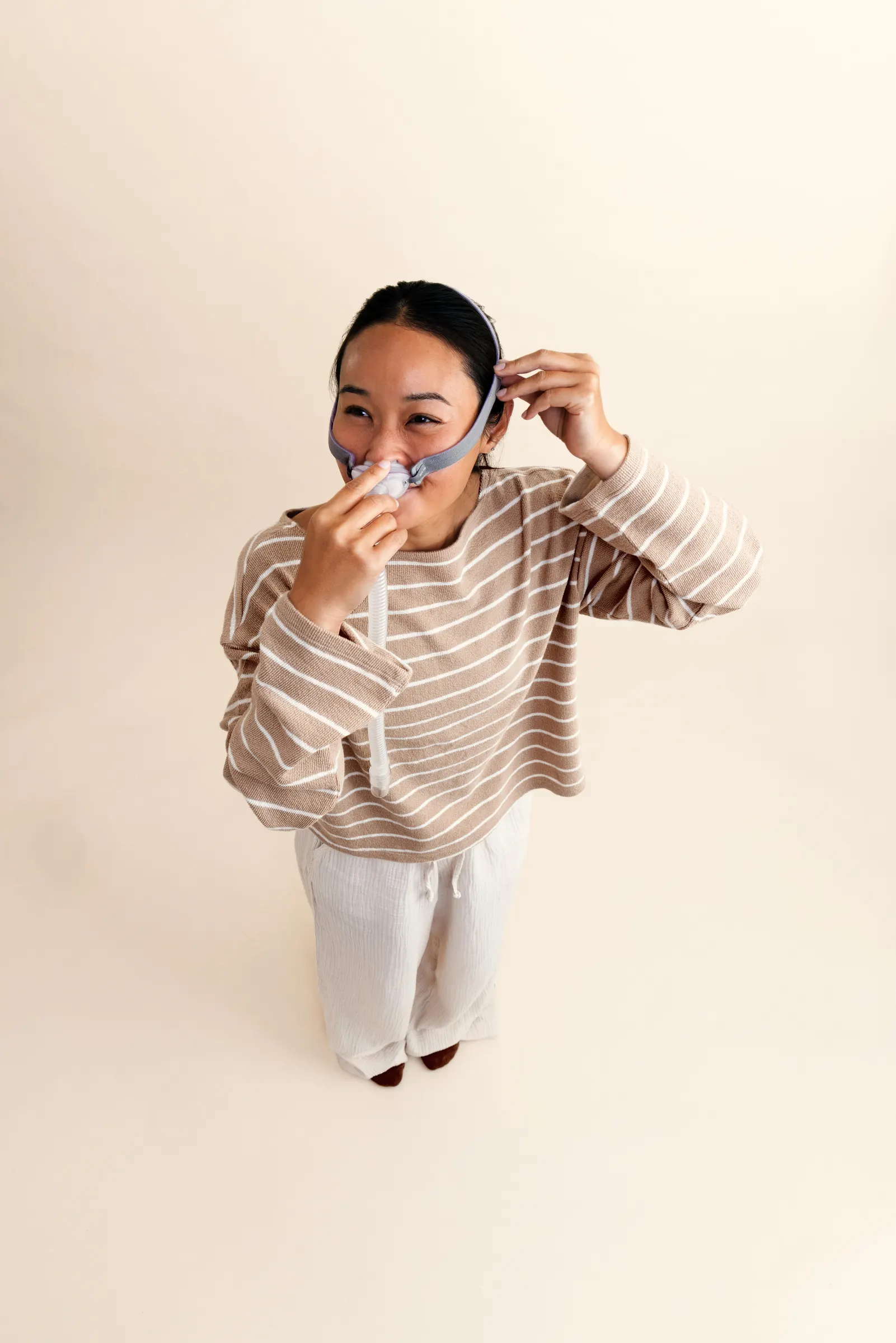
Assistive Devices Program (ADP) billing for CPAP clinics.
The Assistive Devices Program (ADP) is the Ontario Ministry of Health programme that pays part of the price of respiratory equipment, and this page is about what that does to your invoice, not about whether a patient qualifies.
Who does what
The programme, the vendor and the person who signs.
Three roles the programme defines, and the one that is different for respiratory equipment.
The 75% model
What the 75% model does to your invoice.
The programme pays a percentage of a price it sets, not a percentage of what you charge.
The usual case: 75% and 25%
The programme pays 75% of its approved price for the device, and the client's portion is at least 25% of the cost of the device.
- You cannot charge the client more than the approved price for a funded device.
- Items that are not part of the positive airway pressure system can be billed to the client in full.
- Replacement masks and headgear for a CPAP machine are not funded, so resupply is a private or patient-paid line.
- A service package has to be offered as a separate, optional purchase.
Social assistance: 100%
Where the client receives Ontario Works, the Ontario Disability Support Program or Assistance for Children with Severe Disabilities as at the date the prescriber reviewed and approved the application, the programme pays 100% of the approved price.
- The invoice carries a benefit code saying which programme that is.
- The share the client would have paid is settled between the ministries, not at your counter. See ODSP and Ontario Works on a funded invoice.
- Where the programme cannot confirm the status itself, the vendor is asked to get confirmation from the client.
Sample
A positive airway pressure system at the approved price
| Item | Amount |
|---|---|
| Positive airway pressure system, approved price | $554.00 |
| Invoice total | $554.00 |
| Assistive Devices Program (ADP) 75% of the approved price | -$415.50 |
| Patient owed | $138.50 |
Sample figures, not a real patient. The client pays their 25% directly to the business that sold the equipment.
Sample figures, not a real patient. Invoice lines carry no tax unless the catalogue item is taxable, and respiratory supplies are set up zero rated.
What the invoice must show
The data the programme asks every vendor for.
Sixteen essential items on every invoice submitted to the programme, plus the proof of delivery kept at your location.
In norvelle
The programme share, built once and applied.
The Assistive Devices Program is the payer whose coverage rule is already set up in the payer directory. The rest is your clinic's own setup.
- The rule is a percentage of a named approved price, which is how the programme pays.
- The approval number is captured on the programme's share, and the payer can be set to require one.
- The patient's remainder is what is left after every payer share, worked out rather than typed.
- The programme's share can be billed as its own numbered invoice, so that debt ages apart from the patient's.
- The printed invoice can carry a funding-audit signature declaration with named parties, set per brand and per location.
- Your team submits the claim to the programme. norvelle records the split, the number and the money.
Questions vendors ask.
Sources
Captured 2026-10-16. Every programme fact on this page was read from the Ontario Ministry of Health's own published pages and manuals on that date. Programme rules change: check the source before you rely on it.
- 75% of the approved price, the client's portion of at least 25%, and the rule that a vendor cannot charge the client more than the approved price: Policies and Procedures Manual for the Assistive Devices Program, policy 305, files.ontario.ca/moh-adp-policies-and-procedures-manual-assistive-devices-program-2023-07-01.pdf (July 2023).
- Definitions of Authorizer and Vendor: the same manual, policies 110.09 and 110.22.
- The sixteen essential invoice data items, serial numbers required for respiratory equipment and supplies, separate itemisation of components, and the benefit codes: the same manual, policies 915.01 to 915.04.
- Invoice files submitted by email to the ministry's Financial Management Branch, and the programme supplying no software for making that file: the same manual, policies 920.03 and 920.04. Invoices held in full on an error, no partial payment, dropped after ninety days: policies 925.02 to 925.05.
- Original client signature and date on or with every invoice on file at the vendor location as proof of delivery, and the accepted alternatives: the same manual, policy 935.
- Respiratory specifics: the prescriber definition, the physician registered as a prescriber of positive airway pressure systems, the client paying the vendor the 25% portion, 100% of the approved price for recipients of Ontario Works, the Ontario Disability Support Program or Assistance for Children with Severe Disabilities, items outside the system billable to the client, optional service packages, and the fully itemized invoice handed over with the device: Respiratory Equipment Policy and Administration Manual, policies 110.09, 115, 300, 600, 605, 610 and 615, ontario.ca/files/2024-11/moh-adp-policy-and-administration-manual-respiratory-equipment-2024-11-08.pdf (July 2024).
- What is covered and what is not, including replacement masks and headgear for CPAP machines, and the share paid directly to the business that sold the equipment: ontario.ca/page/respiratory-equipment-and-supplies (page updated 2026-02-18).
- Vendor registration: the forms, the signed Vendor Agreement, reporting a change within 10 days, and the six month target for reviewing an application: ontario.ca/document/assistive-devices-program-health-care-professionals/register-authorizer-or-vendor (page updated 2026-04-30).
- Coverage of the client's contribution for people on social assistance: Ontario Disability Support Program directive 9.6, ontario.ca/document/ontario-disability-support-program-policy-directives-income-support/96-assistive-devices (updated 2026-03-10), and Ontario Works directive 7.8, ontario.ca/document/ontario-works-policy-directives/78-assistive-devices (updated 2026-04-14).
- Device codes and approved prices are listed in the programme's own product manual: Respiratory Devices Product Manual, ontario.ca/files/2026-04/moh-adp-policy-and-administration-manual-respiratory-equipment-en-2026-04-01.pdf (effective 2026-04-01).